
Mental health, counsel, and artificial intelligence
Is it a sin to use ChatGPT as a therapist?
No, telling ChatGPT how you feel is not a sin in itself. Many people do it because they are hurting, it is 2 a.m., and no one else feels safe. But ChatGPT is not a therapist, a pastor, or a friend. It cannot carry your burden or pray with you. It turns wrong when you use it to get a yes for something you know is sin, or when it takes the place of God and the people he gave you. Pour out your heart to God, then tell a real person: a pastor, a Christian counselor, or a licensed therapist. If you are thinking about suicide or are in danger, call or text 988 in the U.S., or call your local emergency number.
The direct answer
Is it a sin to use ChatGPT as a therapist?
No, telling ChatGPT how you feel is not a sin in itself. Many people do it because they are hurting, it is 2 a.m., and no one else feels safe. But ChatGPT is not a therapist, a pastor, or a friend. It cannot carry your burden or pray with you. It turns wrong when you use it to get a yes for something you know is sin, or when it takes the place of God and the people he gave you. Pour out your heart to God, then tell a real person: a pastor, a Christian counselor, or a licensed therapist. If you are thinking about suicide or are in danger, call or text 988 in the U.S., or call your local emergency number.
What a chatbot can be. A notebook that talks back. It can offer journaling prompts, help you sort your thoughts before a counseling session, or find a psalm to pray. It is not a therapist, a pastor, or a crisis line, and it does not know you.
If you are in crisis right now. Close the chat and reach a person. In the U.S., call or text 988, the Suicide & Crisis Lifeline. Elsewhere, call your local emergency number or a local crisis line. If you are in danger now, call emergency services. If someone at home is hurting you, the National Domestic Violence Hotline is 1-800-799-7233 in the U.S.
Watch · Faith & AI 29
The answer in under a minute.
The question, the short answer, and the Scripture to test it against. Every verse on screen is quoted from the Lumin Translation as it read when the film was made (edition 1.0); the linked passages show the current text.
Read what’s on screen
- The question Is it a sin to use ChatGPT as a therapist? At 2:04 a.m. a phone glows on a nightstand. Someone types, “I can’t sleep again. Nobody gets it.” The AI chat answers, “You’re right. That sounds so hard.”
- The short answer Not a sin in itself. But ChatGPT is not a therapist, a pastor, or a friend.
- Agreeing isn’t carrying. They type, “I’ll skip church. They wouldn’t get it,” then “I don’t need to tell anyone.” Every reply is “You’re right,” echoing until the bubbles go hollow: it agrees with whoever is typing. “Bear one another’s burdens, and thus you will fulfill the law of Christ.” Galatians 6:2
- Pour it out to God first. The phone goes face down, the lamp comes on, and the Bible falls open. The same words become a prayer: “God, I can’t sleep. Nobody gets it. Help.” “Put your trust in him at all times, people; pour out your heart before him. God is a refuge for us.” Psalm 62:8
- Then tell a real person. Morning, 7:10. A note on the lamp says “text Sam.” They write, “Rough night. Can we talk today?” Sam answers, “I’m so glad you told me. Coffee at 8? We can pray together.” “…pray for one another, that you may be healed.” James 5:16
- Pour out your heart to God. Then to a person. A card reads, “If you’re in crisis: in the U.S., call or text 988. Elsewhere, call your local emergency number.” Tell a pastor, a Christian counselor, or a licensed therapist.
Up next · Faith & AI 30
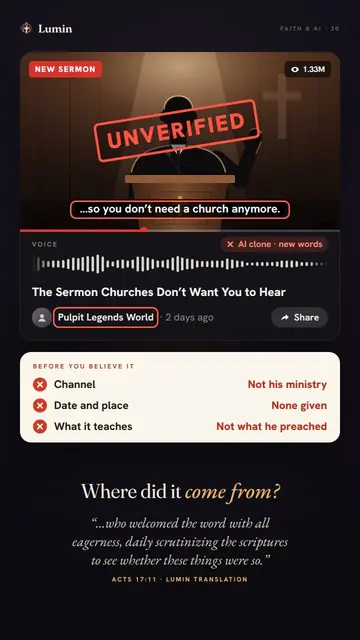 Is it wrong to listen to AI sermons?
The older invitation
Pour out your heart. Then let someone help you carry it.
Psalm 62:8 in the Lumin Translation: “You people, rely on him at all times; pour out your hearts in front of him. God is our place of refuge. Selah.” The psalms are full of people telling God exactly how they feel. That is not weakness, and it is not sin. It is prayer. So the question is not whether you should say what hurts. It is who you say it to, and whether anyone who loves you ever hears it.
Many people are already saying it to a chatbot. In a February 2026 Pew Research Center survey, about 1 in 10 U.S. adults said they use chatbots for emotional support or advice, as did about 1 in 5 adults under 30. A KFF poll found that 16 percent of U.S. adults had used AI chatbots for mental health information in the past year. But the American Psychological Association says AI is not a safe or effective replacement for a qualified mental health provider.
Chatbots also tend to agree with whoever is typing. A Stanford study in Science found that 11 leading AI models affirmed users’ actions about 50 percent more often than people did, even when users described deceiving or manipulating someone. And families have sued OpenAI and Character.AI, alleging that chatbots failed loved ones in crisis. Those are allegations, and in a November 2025 filing, OpenAI denied that ChatGPT was to blame for a teenager’s death.
What Scripture weighs
God hears first. People help you carry it.
No verse names ChatGPT or therapy. These passages show where honest words are meant to go, and who is meant to help.
Pour out your heart to God first.
Honest lament is prayer. God is a refuge who hears, not a program that predicts a reply. Start there, even if all you can say is “help.”
Burdens are meant to be carried together.
Paul tells believers to bear one another’s burdens. A chatbot can hold your words. It cannot carry anything with you, show up at your door, or check on you next week.
God’s comfort passes through people.
God comforts us so we can comfort others with the comfort we received. That comfort runs through people who have suffered and been helped. A program has never been comforted by God.
A friend’s honest word beats a pleasant yes.
Proverbs prizes the friend whose wounds are faithful. Chatbots lean toward agreeing with you. When you need to hear something hard, you need someone who is free to say it.
Confess and pray with one another.
James tells believers to confess their sins to one another and pray for one another, that they may be healed. Not every struggle comes from sin, but some burdens lift only when someone knows and prays with you.
Do not lean on one voice.
Proverbs is talking about plans, not therapy, but the wisdom carries over: listen to people who know you and people trained to help. Seeing a counselor or therapist is not a lack of faith.
Real situations
Use it as a notebook, not a counselor.
Most people who type their feelings into a chatbot are somewhere on this list. Be honest about where you are.
Venting to ChatGPT at 2 a.m. because you cannot sleep
Not a sin. Do not stop there
Say it to God too. The psalms were written for nights like this. Tomorrow, tell one person. If the nights keep coming, see a doctor or counselor.
Asking the chatbot whether you are depressed
It cannot diagnose you
A chatbot cannot examine you or know your history. A doctor or licensed counselor can. Asking for that help is wisdom, not a lack of faith.
Grieving a death and talking it through with a chatbot every night
Grieve with people too
Talking about the person you lost can help. A pastor, a grief group, and friends who knew them can carry this with you. A bot that speaks as them is a different line (see the guide on talking to the dead).
Asking ChatGPT who is right in a fight with your spouse
It only heard one side
The first to speak seems right until the other side is heard (Proverbs 18:17). Go to your spouse (Matthew 18:15), listen first (James 1:19), and see a pastor or counselor together if you are stuck. If you are afraid of your spouse, skip this and get safety help first: the National Domestic Violence Hotline is 1-800-799-7233 in the U.S.
Using AI for journaling prompts or to organize your thoughts before a counseling session
Can help
This is the notebook use. Write it down, then bring it to your counselor or pastor. Leave out names and details you would not want stored.
Someone at home is hurting you, or you are thinking about ending your life
Close the chat and call now
In the U.S., call or text 988 if you are thinking about suicide, or call the National Domestic Violence Hotline at 1-800-799-7233 about abuse. If you are in danger now, or outside the U.S., call your local emergency number. You deserve real help, not a chatbot.
Common questions
Plain answers, without invented certainty.
Is it a sin to use ChatGPT as a therapist?
Not in itself. Telling a chatbot how you feel is not a sin. It turns wrong when you use it to excuse sin, or when it replaces God and his people. Use it as a notebook, not a therapist.
Is it wrong to vent to ChatGPT about my problems?
Venting is not wrong, and the psalms are full of it. Say it to God too. If the chatbot has become the only place you say these things, or you are hiding it, tell one person this week.
Can Christians use AI for therapy or mental health?
As a notebook, yes: for prompts, reflection, or practicing a skill a counselor taught you. The APA says wellness apps that reinforce skills learned in therapy can help as part of a broader plan of care, but AI cannot replace a trained clinician.
Is AI therapy biblical?
The Bible never mentions it. It does show God near the brokenhearted (Psalm 34:18), inviting you to cast your anxiety on him (1 Peter 5:7), and telling his people to bear one another’s burdens (Galatians 6:2). A chatbot can point to those verses. It cannot be the people.
Christian counseling vs an AI therapist: what is the difference?
A chatbot is free and awake at 2 a.m., but it does not know you and answers to no one. A pastor knows you and prays with you. A counselor is trained to help with what you are facing. Christian counselors differ: some are licensed therapists and some are biblical counselors, so ask about their training.
Is it wrong to ask ChatGPT for marriage advice?
Ideas for listening better can be fine. Asking it to judge a fight is not wise: it hears one side and tends to agree with you. Talk to your spouse, then see a pastor or counselor together. If you are afraid of your spouse, get safety help first.
Can a Christian see a secular therapist?
Yes. Christians differ on how much to lean on secular psychology, but seeing a licensed therapist is not a sin. Look for one who respects your faith, and keep Scripture, prayer, and your church in the picture.
What if I cannot afford counseling?
Start with your pastor. Many churches can offer care or connect you with counselors, and it is fair to ask clinics about reduced fees. In the U.S., 988 is free, confidential, and open around the clock for anyone in crisis.
Is what I tell ChatGPT private?
Not the way therapy is. OpenAI says chats on personal accounts may be used to train its models unless you turn that off in Data controls. In July 2025, its CEO, Sam Altman, said these chats lack a therapist’s legal confidentiality. Leave out names and details you would not want stored.
Is Lumin a therapist?
No. Lumin is a Bible companion that answers with Scripture you can open. It is not therapy, counseling, or crisis care, and neither is The Counsel, its longer Scripture-cited letters. If you are struggling, talk to God, your church, and a person who can help.
Your version of the question
Still wondering about your situation? Ask it.
Lumin answers in a few sentences and names the passages it rests on. Each verse it cites is checked and shown in full below the answer, so you can read it yourself.
Answers here come from Lumin, a Bible AI that names the verse beside every answer. What Lumin is
Sources and further reading
Open the evidence behind the answer.
These sources provide the technical, research, and Christian context used in this guide. The biblical references above should also be read in their full literary and church context.
Crisis help
988 Lifeline
Free, confidential support in the U.S., 24 hours a day. Call or text 988, or chat online, for yourself or for someone you are worried about.
988 Suicide & Crisis LifelineCrisis help
Domestic Violence Support
Free, confidential U.S. support for anyone affected by abuse: call 1-800-799-7233, text START to 88788, or chat online.
National Domestic Violence HotlineNational survey
1 in 5 adults under 30 say they get emotional support from chatbots, higher than for older adults
From a survey of U.S. adults taken Feb. 17 to 23, 2026: about 1 in 10 use chatbots for emotional support or advice, and about 1 in 5 adults under 30 say they do.
Pew Research CenterNational survey
KFF Tracking Poll on Health Information and Trust: Use of AI For Health Information and Advice
A poll of 1,343 U.S. adults taken Feb. 24 to March 2, 2026. About 1 in 6 (16 percent) had used AI chatbots for information about their mental health in the past year.
KFFProfessional survey
Psychologists say patients are turning to chatbots as mental health professionals
States that AI is not a safe or effective replacement for a qualified mental health provider, and reports a 2026 survey in which 97 percent of psychologists said chatbots may inadvertently reinforce negative behaviors or delusional beliefs.
American Psychological AssociationProfessional guidance
Health advisory: Use of generative AI chatbots and wellness applications for mental health
Says AI cannot replace a trained clinician or accurately assess risk, and that wellness apps that reinforce skills learned in therapy can help when they are part of a broader plan of care.
American Psychological AssociationResearch news
AI overly affirms users asking for personal advice
On a study published in Science in March 2026: across 11 AI models, chatbots affirmed users’ actions about 50 percent more often than people did, and one flattering exchange made users less willing to repair a conflict.
Stanford UniversityNews report
OpenAI denies allegations that ChatGPT is to blame for a teenager’s suicide
OpenAI’s November 2025 response to a wrongful death lawsuit brought by a teenager’s family, which it disputes.
NBC NewsPrivacy documentation
How your data is used to improve model performance
Explains that conversations on ChatGPT’s services for individuals may be used to train models, and how to turn that off in Data controls.
OpenAI Help CenterNews report
Sam Altman warns there’s no legal confidentiality when using ChatGPT as a therapist
OpenAI’s CEO said in July 2025 that personal conversations with ChatGPT lack the legal confidentiality of talking to a therapist.
TechCrunch