
Bible AI, accuracy & authority
Can AI interpret the Bible?
AI can assist by finding passages, summarizing known viewpoints, and organizing context. It can also invent citations, flatten disagreement, and sound certain when wrong. Treat every generated explanation as a fallible study aid: open the passage, check trustworthy sources, and keep consequential judgment with accountable people in the church.
The direct answer
Can AI interpret the Bible?
AI can assist by finding passages, summarizing known viewpoints, and organizing context. It can also invent citations, flatten disagreement, and sound certain when wrong. Treat every generated explanation as a fallible study aid: open the passage, check trustworthy sources, and keep consequential judgment with accountable people in the church.
What AI can do. Retrieve passages, organize observations, compare published interpretations, explain unfamiliar terms, and help you ask a more precise question.
What AI cannot do. Guarantee truth, possess faith or the Holy Spirit, know God’s private will, bear pastoral responsibility, or replace Scripture read in Christian community.
Watch · Faith & AI 18
The answer in under a minute.
The question, the short answer, and the Scripture to test it against. Every verse on screen is quoted from the Lumin Translation as it read when the film was made (edition 1.0); the linked passages show the current text.
Read what’s on screen
- The question Can AI interpret the Bible? A chatbot’s reading of Philippians 4:13: “It means you can achieve any goal you set.”
- Philippians 4:13 “I have strength for all things through the one who empowers me.” Philippians 4:13
- The short answer It can help you study. It can’t be the final word.
- Read the paragraph. “…I have learned in whatever situation I am to be content.” Philippians 4:11
- Read the chapter. “They read clearly from the book of God’s law and explained its meaning…” Nehemiah 8:8
- Read the whole letter. Philippians, all four chapters.
- Read the whole Bible. “…daily scrutinizing the scriptures to see whether these things were so.” Acts 17:11
- Read it with people. “And let us consider one another to stir up love and good works.” Hebrews 10:24
- The takeaway A study assistant. Not an oracle.
Up next · Faith & AI 19
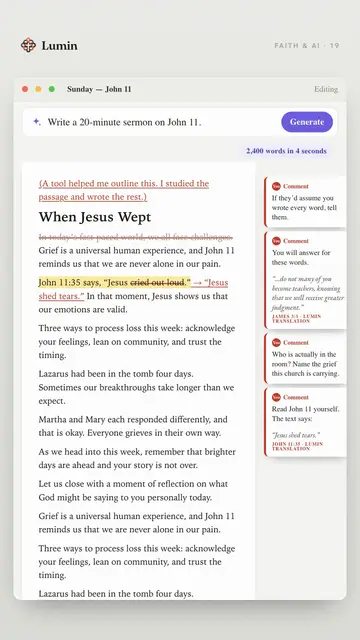 Can AI write a sermon?
Start with the right category
A language model produces an answer; it does not become an authority.
Generative AI predicts and arranges language from patterns in data. That can produce a useful summary, but it can also produce a plausible error. NIST calls confidently presented false output “confabulation,” a known risk of generative systems rather than a rare theological exception.
Bible interpretation also involves more than matching words. Genre, historical setting, the argument of a book, the wider canon, Christian tradition, prayer, moral formation, and responsibility to a real community all matter. An AI tool may describe those dimensions; it does not inhabit them or become accountable for the conclusion.
Six checks for a Bible AI answer
Keep the passage closer than the explanation.
These checks are useful whether the answer comes from Lumin, a general chatbot, a study note, a video, or another person. The source deserves more trust than the confidence of its interpreter.
Open the passage yourself.
The Bereans examined the Scriptures to test what they heard. Confirm the quoted words and reference before accepting the explanation built on them.
Read for context and sense.
Notice the paragraph, book, genre, speaker, audience, and purpose. A detached verse can support a claim its surrounding argument does not.
Admit what is difficult.
Some passages are genuinely hard. Be suspicious when a tool erases complexity, meaningful Christian disagreement, or uncertainty with one polished answer.
Ask who is accountable.
Teachers carry responsibility for what they teach. Software cannot know you, repair harm, receive correction as a person, or bear pastoral responsibility.
Keep interpretation communal.
Christian reading belongs within worship, teaching, correction, and mutual care. Private software should not quietly become your only theological community.
Seek wisdom, not only information.
A summary can supply information. Wisdom also requires prayer, character, obedience, and discernment about how truth should be lived.
Where AI helps—and where it should stop
Use it as a study assistant, not an oracle.
The same answer can be low-risk exploration in one setting and spiritually consequential counsel in another. The role you give the tool matters.
Finding a passage or cross-reference
Useful starting point
Open the result in a Bible, confirm the wording, and read what surrounds it.
Comparing established interpretations
Helpful with named sources
Ask which tradition or commentator holds each view, then inspect the source instead of trusting an unattributed synthesis.
Greek, Hebrew, history, or cultural background
Verify independently
Models can invent definitions, dates, quotations, and citations. Check a lexicon, translation note, or reputable scholarly source.
Building a doctrine from one answer
Not sufficient
Read the wider biblical witness and consult accountable teachers. Do not let one generated synthesis quietly settle a disputed doctrine.
“What is God telling me to do?”
The tool is in the wrong role
AI cannot know God’s private will, receive revelation for you, or replace prayer, conscience, wise counsel, and pastoral care.
After the method
A companion is not the interpreter either.
After you have a verification method: if you want cited Scripture you can open, start with Bible AI or Ask. If the question is whether to just use ChatGPT, see the honest jobs split — not a compare-farm ranking. Lumin names passages; it is still a fallible aid — not commentary, Holy Spirit, or pastor.
Common questions
Plain answers, without invented certainty.
Can AI interpret the Bible?
AI can assist by finding passages, summarizing known viewpoints, and organizing context. It can also invent citations, flatten disagreement, and sound certain when wrong. Open the passage, check trustworthy sources, and keep consequential judgment with accountable people in the church.
Can AI interpret Scripture?
Useful as a study assistant, never as oracle, commentary replacement, or pastor. Find, outline, and compare viewpoints — then open the passage and keep judgment with the church.
Is AI accurate when explaining the Bible?
Sometimes — not reliably enough to skip verification. Check every important claim against the text and named sources.
Can AI understand Scripture?
AI can process the language of Scripture and human writing about it. That is not the same as human understanding shaped by embodiment, faith, worship, moral responsibility, relationships, and lived obedience. It can assist study without possessing a spiritual life.
Does AI have the Holy Spirit?
No. AI is human-built software. It can generate language about the Holy Spirit, but it does not pray, believe, worship, receive spiritual gifts, or speak for God.
Can AI replace a Bible commentary?
No. A responsible commentary names its author, method, sources, historical setting, and interpretive commitments. AI may summarize commentary-like material, but an unattributed synthesis does not provide the same provenance or accountability.
How can I spot a hallucinated Bible answer?
Open every citation; search for quoted wording; verify names, dates, and original-language claims; ask for the source of each interpretation; and watch for certainty that remains high when the evidence is thin or disputed.
What is a safe way to use Bible AI?
Use it to locate, organize, and question. Keep the Bible open, require visible references, separate Scripture from generated explanation, compare important claims with trustworthy sources, and bring consequential questions to accountable Christians who know you.
Your version of the question
Still wondering about your situation? Ask it.
Lumin answers in a few sentences and names the passages it rests on. Each verse it cites is checked and shown in full below the answer, so you can read it yourself.
Keep going
Keep asking in the Lumin app.Keep this conversation going on the web.
The same short answers with the verse beside each one, plus your saved questions, prayer, and the whole Bible to read in.
Make a free Lumin account and this conversation opens in Ask, ready for your next question. Your saved questions, prayer, and the whole Bible come with it.
Sources and further reading
Open the evidence behind the answer.
These sources provide the technical, research, and Christian context used in this guide. The biblical references above should also be read in their full literary and church context.
Technical risk guidance
Generative AI Profile for the AI Risk Management Framework
NIST documents confabulation—the confident production of erroneous or false material—as a core generative-AI risk and recommends verification and risk management.
National Institute of Standards and TechnologyChristian ethical reflection
Antiqua et nova: Artificial Intelligence and Human Intelligence
This Catholic source distinguishes functional AI output from embodied, relational, moral, and spiritual human intelligence. Lumin cites it as one Christian contribution, not as a universal denominational statement.
Dicasteries for the Doctrine of the Faith and for Culture and EducationNational research
State of the Bible 2026: AI and Biblical Understanding
A nationally representative 2026 survey found substantial public caution about AI-assisted Bible understanding, underscoring that trust and verification are central user concerns.
American Bible Society