
Revelation and artificial intelligence
Can AI speak for God?
No. AI cannot speak for God. A language model can arrange words about God, summarize a commentary, or imitate a religious tone. It cannot receive revelation, carry the Holy Spirit’s witness, or hold a prophetic office. Test every religious-sounding line against Scripture. Keep prayer and discernment with God, your conscience, and the church. Lumin will not speak for God, deliver a word from the Lord, or pretend a reply is the Spirit.
Corrected . The Brentwood Statement was listed as a 2024 statement from several evangelical organizations. It was released in June 2026 by Lifeway with Southern Baptist leaders. The date and signers were corrected. See the corrected sectionCorrections log
The direct answer
Can AI speak for God?
No. AI cannot speak for God. A language model can arrange words about God, summarize a commentary, or imitate a religious tone. It cannot receive revelation, carry the Holy Spirit’s witness, or hold a prophetic office. Test every religious-sounding line against Scripture. Keep prayer and discernment with God, your conscience, and the church. Lumin will not speak for God, deliver a word from the Lord, or pretend a reply is the Spirit.
What this page answers. Whether artificial intelligence can speak for God, prophesy, or be a means of revelation. The question is authority, not whether software may exist.
What this page will not do. Teach a prompt that makes a model sound like God. Treat fluency as the Spirit. Rank products, or speak in the voice of Jesus.
Watch · Faith & AI 02
The answer in under a minute.
The question, the short answer, and the Scripture to test it against. Every verse on screen is quoted from the Lumin Translation as it read when the film was made (edition 1.0); the linked passages show the current text.
Read what’s on screen
- The question Can AI speak for God? The internet has opinions: “it gave me a word from the Lord.” “it knows the Bible better than my pastor.” “it’s just fancy autocomplete.”
- The short answer No. It can arrange words about God. It can’t receive revelation.
- God has already spoken. “In these final days he spoke to us by his Son…” Hebrews 1:2
- Sounding sure isn’t proof. “…do not believe every spirit, but examine the spirits whether they are from God.” 1 John 4:1
- Take big questions to people who know you. “…deliverance is in a multitude of counselors.” Proverbs 11:14
- The takeaway A chatbot can sound sure. That isn’t God speaking. Lumin will never speak as God or as Jesus.
Up next · Faith & AI 03
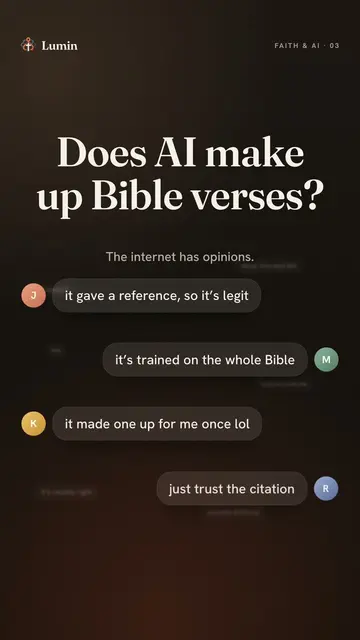 Does AI make up Bible verses?
God has already named how he speaks
A next token is not a word from the Lord.
Hebrews 1:1–2 in the Lumin Translation: “Long ago, at many times and in many ways, God spoke to our ancestors through the prophets, but in these last days he has spoken to us by his Son, whom he appointed heir of all things, and through whom he also made the universe.” Christian faith already has a center for divine speech: the Son, and the Scripture that bears witness to him. A product that offers “a word from the Lord” is claiming an office it cannot hold.
The Holy Spirit is not a feature you switch on inside a model. The Spirit convicts, guides, and indwells persons. Software can reproduce the vocabulary of that work. It cannot pray, believe, or stand in the place of the One who speaks. Churches and ethicists who have written on AI — including the Brentwood Statement, the ERLC, and The Gospel Coalition — keep the tool beneath spiritual authority. Lumin cites them as Christian contributions, not as a denomination taking over this page.
Why a model cannot be the voice
Scripture already locates divine speech.
These passages are not a manual for chatbots. They are why “the AI said God told me” is a category error.
God has spoken by the Son.
The claim of Christian faith is that God has spoken, climactically, in Jesus. A generated paragraph does not become that speech because it uses biblical cadence.
God-breathed speech is Scripture.
All Scripture comes from the breath of God. A model’s output is not added to that canon, and it is not a private appendix to the Bible.
Do not presume to speak in the Lord’s name.
Claiming a word the Lord has not commanded is an old sin. A first-person religious chatbot still makes a claim about whose voice you are hearing.
Test the spirits.
Not every sentence that names God is from God. Confidence, warmth, and a verse number are reasons to open the passage, not reasons to obey the chat.
The Spirit is not software.
Jesus speaks of the Spirit of truth guiding his people. A statistical model has no spirit to give. It can only rearrange words it was trained on.
Test everything. Hold the good.
Scripture does not say to despise every claim of guidance. It says to test it. A tool that forbids the test is asking for a trust it has not earned.
What people ask the chat to be
Keep the model in the role of a tool.
The words can be about God without being from God. The role you assign is the moral question.
“Give me a word from the Lord.”
The tool is in the wrong office
That request asks a model for revelation. Read Scripture, pray, and take weighty questions to people who know you.
“The Spirit told the chatbot.”
Do not grant that claim
The Spirit is not a product feature. A pious sentence is still generated text until you have tested it.
Drafting an illustration a preacher will judge
A human remains accountable
A pastor may use a tool to organize notes. The sermon is not preached until a responsible person has studied the passage and stood behind the words.
Checking a verse the model cited
Open the chapter
Models invent quotations. A reference is the start of the check, not the end of it.
Common questions
Plain answers, without invented certainty.
Can AI speak for God?
No. AI can arrange words about God. It cannot receive revelation, carry the Spirit’s witness, or hold a prophetic office. Test what it says against Scripture.
Can the Holy Spirit speak through AI?
The Spirit speaks to persons and through the Word. A model can imitate the vocabulary of that work. It is not itself a means of revelation, and it does not have the Spirit.
Can AI prophesy?
No. Prophecy in Scripture is tested, and false claims to speak for the Lord are condemned. A chatbot that offers a private word from God is claiming an office it cannot hold.
Is using AI to study the Bible the same as God speaking?
No. Study help is a tool. God’s speech is not the tool’s output. Open the passage, and keep judgment with Scripture and the church.
Does Lumin speak for God?
No. Lumin will not speak as God, as Jesus, as a prophet, or as a pastor. It cites Scripture you can open. The Covenant states that limit in public.
Your version of the question
Still wondering about your situation? Ask it.
Lumin answers in a few sentences and names the passages it rests on. Each verse it cites is checked and shown in full below the answer, so you can read it yourself.
Keep going
Keep asking in the Lumin app.Keep this conversation going on the web.
The same short answers with the verse beside each one, plus your saved questions, prayer, and the whole Bible to read in.
Make a free Lumin account and this conversation opens in Ask, ready for your next question. Your saved questions, prayer, and the whole Bible come with it.
Sources and further reading
Open the evidence behind the answer.
These sources provide the technical, research, and Christian context used in this guide. The biblical references above should also be read in their full literary and church context.
Evangelical ministry statement
Brentwood Statement on Artificial Intelligence and Christian Ministry
A June 2026 statement from Southern Baptist leaders on wisdom, human dignity, truthfulness, trust, privacy, and faithful leadership in ministry use of AI.
Lifeway Christian Resources and Southern Baptist leadersChristian ethical reflection
When creation creates technology
ERLC research on the creation mandate, human stewardship, and why artificial intelligence remains a human-made tool—not a moral agent.
Ethics & Religious Liberty CommissionEditorial theology
Christians Can Give Two Cheers for AI
TGC argues for hopeful realism: AI reflects human creativity under the creation mandate but cannot receive the wisdom or moral weight that belong to God.
The Gospel CoalitionChristian ethical reflection
Antiqua et nova: Artificial Intelligence and Human Intelligence
The Vatican’s 2025 note distinguishes functional machine output from embodied, relational human intelligence. Lumin cites it as one Christian contribution, not a universal denominational statement.
Dicasteries for the Doctrine of the Faith and for Culture and EducationEditorial theology
When We Make Intelligence in Our Image
Christianity Today on the creation mandate, human personhood, and welcoming AI as human creativity without anthropomorphizing or idolizing it.
Christianity Today