
Worship that belongs to God
Is using AI idolatry?
No—not merely because it is a tool. Idolatry is giving a created thing the trust, fear, or worship that belong to God. Using AI to draft, search, or study is not that act. Treating a model as the voice you obey, the presence you fear, or the savior of your church is. The tool stays a tool. God stays God. Lumin will not ask for the devotion that belongs to him, and it will not speak as Jesus.
The direct answer
Is using AI idolatry?
No—not merely because it is a tool. Idolatry is giving a created thing the trust, fear, or worship that belong to God. Using AI to draft, search, or study is not that act. Treating a model as the voice you obey, the presence you fear, or the savior of your church is. The tool stays a tool. God stays God. Lumin will not ask for the devotion that belongs to him, and it will not speak as Jesus.
What this page answers. Whether using artificial intelligence is idolatry. The question is misplaced worship, not whether software may exist and not whether AI is the beast.
What this page will not do. Call every Christian who uses a chatbot an idolater. Decode Revelation into a product. Offer a ritual for “cleansing” a computer, or speak as God.
Watch · Faith & AI 13
The answer in under a minute.
The question, the short answer, and the Scripture to test it against. Every verse on screen is quoted from the Lumin Translation as it read when the film was made (edition 1.0); the linked passages show the current text.
Read what’s on screen
- The question Is using AI idolatry? A phone stands on a pedestal under a spotlight, labeled “A Tool: glass, aluminum, predicted language.”
- The short answer Not merely because it’s a tool. Idolatry is giving a made thing the trust, fear, or worship that belong to God.
- The maker bows to what he made. He makes the rest of it into a god, his carved image; he bows down to it and worships, prays to it, and says, “Save me, for you are my god.” Isaiah 44:17
- Use, not idolatry Drafting. Searching. Checking the verse it cited.
- Worship: the tool in the wrong place Asking it what God wants, then obeying the reply.
- You don’t need a shrine. The phone turns gold. Fear, fascination, dependence. “Their idols are silver and gold, crafted by the hands of men.” Psalm 115:4
- The takeaway The spotlight leaves the pedestal. Use the tool. Don’t bow to it. “…You shall worship the Lord your God, and him alone shall you serve.” Matthew 4:10
Up next · Faith & AI 14
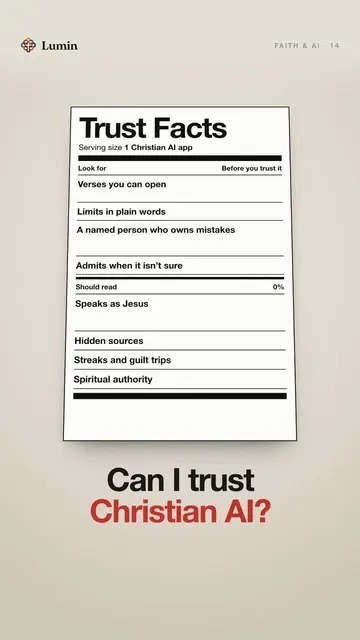 Can I trust Christian AI?
The older danger
Idolatry is a direction of the heart, not a brand of software.
Exodus 20:3 in the Lumin Translation: “Do not have any other gods before me.” Isaiah 44 pictures a man who warms himself with one part of a log and, with the residue, makes a god and says, “Save me, for you are my god!” Romans 1:25 names the exchange: worshiping and serving the creature more than the Creator. First John 5:21 is the short command: “Little children, keep yourselves from idols.” The maker bowing to what he made is an old story. A language model is another thing human hands made.
The image-of-the-beast page already refuses to treat a chatbot as a secret of Revelation, and it names idolatry as a different question. The sin page asks whether a use is honest, loving, and kept from a throne it cannot hold. Neither of those pages is this question. Derek Schuurman, writing for the Calvin Institute of Christian Worship, puts the line in one sentence: when trust that belongs to the Creator moves onto something in creation, you have an idol. Machines are machines. God is God. People are people.
What counts as bowing
Use is not worship. Worship is not use.
These texts do not mention neural networks. They do say what an idol is, and what must not receive it.
No other gods before him.
The command is exclusive worship, not a ban on tools. A hammer is not a god. A hammer you trust to save you has been put in the wrong place.
The maker falls down before his own work.
Isaiah’s idolater uses the same tree for fire and for a god. The absurdity is the bow, not the craft. Generating text and then obeying it repeats that shape.
Idols are the work of men’s hands.
Scripture’s idols are made things. Speech from a model does not cancel that. Fluency is not life, and it is not a reason to pray to the product.
The creature more than the Creator.
Idolatry is an exchange of trust and service. If the model becomes the voice you consult first and last about God, the exchange has started.
Worship the Lord your God only.
Jesus answers the tempter with exclusive worship and service. A study aid can sit on the desk. It cannot share that sentence.
Keep yourselves from idols.
The warning is short because the drift is ordinary. Fear, fascination, and dependence are enough. You do not need a shrine.
Where the line actually falls
Most uses are not worship. Some are.
Do not flatten this into “AI is an idol” or “AI is morally nothing.” Ask what you are giving it.
Drafting notes, searching a fact, or outlining a lesson you will check
Not idolatry
That is use. You remain the one who judges, and God remains the one you worship.
Asking a model what God wants, then obeying the reply
The tool is in the wrong place
That is not study. It is treating a made thing as the voice of God. Read Scripture. Pray. Ask a person who knows you.
Fearing AI as a demon you must appease
Do not grant it that dignity
Panic can become its own devotion. AI is not the beast and not an unclean spirit you negotiate with. It is also not nothing. Judge the use.
A pitch that AI will save the church
Refuse the salvation claim
Christ saves. A growth tool that asks for the trust that belongs to him is asking to be an idol, even in religious language.
Checking a verse the model cited, then closing the chat
This is the right use
The Bible stays the authority. The model stays a fallible index. That order is the opposite of worship.
The model has become the first and last voice in your day
Name the mastery
Paul’s “I will not be mastered by anything” still applies. If you cannot close it, the tool is no longer only a tool. See Is using AI a sin? for that test.
Common questions
Plain answers, without invented certainty.
Is using AI idolatry?
Not merely because it is AI. Idolatry is giving a created thing the trust, fear, or worship that belong to God. Drafting and study are not that act. Obeying a model, fearing it as a spirit, or trusting it to save the church is.
Is AI an idol?
The software is a made thing, like other tools. It becomes an idol in the biblical sense when a person worships it, serves it, or treats it as a god. The object does not become an idol by existing.
Is using ChatGPT idolatry?
Not automatically. The same line applies: honest use is not worship. Treating ChatGPT as the voice of God, or as the presence you cannot put down, is a different act. The sin guide covers the wider conscience test.
Is fearing AI as a demon the same as idolatry?
It is a different mistake that can still give the tool too much spiritual weight. Do not worship it, and do not appease it. Read Is AI the image of the beast? before you turn a product into prophecy.
Does the Bible call technology idolatry?
The Bible does not name modern AI. It forbids giving any created thing the place of God. Craft, wealth, and images are the old cases. The principle reaches a chatbot without a proof-text that says “AI.”
Will Lumin ask me to trust it as God?
No. Lumin will not speak as Jesus, as God, or as a pastor. It cites Scripture you can open and disagree with. The Covenant is the public form of that refusal.
Your version of the question
Still wondering about your situation? Ask it.
Lumin answers in a few sentences and names the passages it rests on. Each verse it cites is checked and shown in full below the answer, so you can read it yourself.
Keep going
Keep asking in the Lumin app.Keep this conversation going on the web.
The same short answers with the verse beside each one, plus your saved questions, prayer, and the whole Bible to read in.
Make a free Lumin account and this conversation opens in Ask, ready for your next question. Your saved questions, prayer, and the whole Bible come with it.
Sources and further reading
Open the evidence behind the answer.
These sources provide the technical, research, and Christian context used in this guide. The biblical references above should also be read in their full literary and church context.
Christian ethical reflection
Derek Schuurman on using artificial intelligence in church
Schuurman warns that replacing trust in the Creator with something in creation is idolatry, and that machines are not people and not God.
Calvin Institute of Christian WorshipEvangelical ministry statement
Brentwood Statement on Artificial Intelligence and Christian Ministry
A June 2026 statement from Southern Baptist leaders on wisdom, human dignity, truthfulness, trust, privacy, and faithful leadership in ministry use of AI.
Lifeway Christian Resources and Southern Baptist leadersChristian ethical reflection
When creation creates technology
ERLC research on the creation mandate, human stewardship, and why artificial intelligence remains a human-made tool—not a moral agent.
Ethics & Religious Liberty CommissionEditorial theology
Christians Can Give Two Cheers for AI
TGC argues for hopeful realism: AI reflects human creativity under the creation mandate but cannot receive the wisdom or moral weight that belong to God.
The Gospel CoalitionChristian ethical reflection
Antiqua et nova: Artificial Intelligence and Human Intelligence
The Vatican’s 2025 note distinguishes functional machine output from embodied, relational human intelligence. Lumin cites it as one Christian contribution, not a universal denominational statement.
Dicasteries for the Doctrine of the Faith and for Culture and EducationEditorial theology
When We Make Intelligence in Our Image
Christianity Today on the creation mandate, human personhood, and welcoming AI as human creativity without anthropomorphizing or idolizing it.
Christianity Today