
Babel, builders, and artificial intelligence
Is AI playing God?
Building AI is not playing God by itself. God made people to create, cultivate, and build, and a new tool can serve that calling. Babel’s sin was not the bricks. It was a plan to make a name and reach heaven on human terms. AI crosses into playing God when builders promise salvation, immortality, or a mind to worship, or when a few gather power that answers to no one. Christians can build and use AI as stewards: every tool under God, in service of neighbors, and honest about its limits.
The direct answer
Is AI playing God?
Building AI is not playing God by itself. God made people to create, cultivate, and build, and a new tool can serve that calling. Babel’s sin was not the bricks. It was a plan to make a name and reach heaven on human terms. AI crosses into playing God when builders promise salvation, immortality, or a mind to worship, or when a few gather power that answers to no one. Christians can build and use AI as stewards: every tool under God, in service of neighbors, and honest about its limits.
What is good in it. Making tools, healing disease, translating languages, and easing work belong to the dominion God gave people. Christians can do this work gladly.
What turns it into Babel. Seeking a name that rivals God’s, promising what only God gives, building a mind to be obeyed as God, or gathering power that answers to no one.
Watch · Faith & AI 27
The answer in under a minute.
The question, the short answer, and the Scripture to test it against. Every verse on screen is quoted from the Lumin Translation as it read when the film was made (edition 1.0); the linked passages show the current text.
Read what’s on screen
- The question Is AI playing God? A woodcut tower goes up block by block: data, chips, models, agents.
- The short answer Making tools isn’t the sin. Making a god is.
- People were made to build. “…Be fruitful, multiply, fill the earth, subdue it…” Genesis 1:28
- Babel wanted a name. A red top tier, “god-like,” is lowered on with its promises: ends death, a mind to obey, answers to no one. “…let us make ourselves a name…” Genesis 11:4
- The sin was the aim, not the brick. The top tier breaks into the letters of many languages. “…there Yahweh confounded the speech of all the earth.” Genesis 11:9
- Build under God. The blocks are relabeled: translate, heal, teach, ease work. “Unless Yahweh builds the house, its builders labor in vain.” Psalm 127:1
- Only God gives life. “AI will end death” is struck through. “…he himself gives everyone life and breath, and all things.” Acts 17:25
- The takeaway Make things. Don’t make a god.
Up next · Faith & AI 28
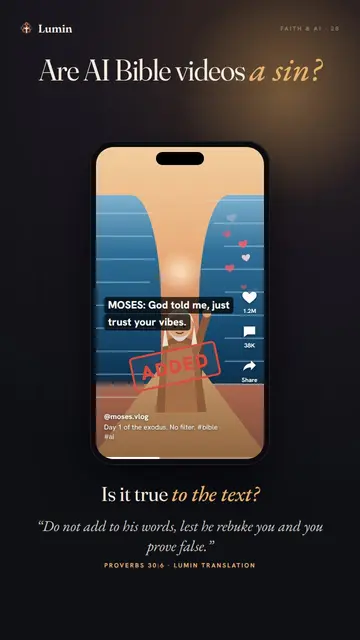 Are AI Bible videos a sin?
The oldest story about building
Let us make a name for ourselves.
Genesis 11:4 in the Lumin Translation: “Then they said, ‘Come, let us build ourselves a city and a tower with its top in the heavens, and let us make a name for ourselves, so that we are not scattered over the face of the whole earth.’” Their problem was not engineering. It was ambition turned against God: a name for themselves, a reach toward heaven, and a refusal to fill the earth as God had told them. God scattered them. At Pentecost, he gathered people of every language again, by his Spirit.
Some in the technology industry speak openly about building god-like intelligence, and some Christians answer that all AI is Babel. Neither extreme holds. Computer scientist Mark Sears, interviewed by The Gospel Coalition, separates AI as a tool for human flourishing from the push to replicate human minds and build a superintelligence, which he calls an attempt to create our own god. The question for any project is the one Babel failed: whose name is it for, and whom does it serve?
Builders under God
Make things. Do not make a god.
Scripture blesses human making and warns against human pride. Both apply to AI.
People were made to build.
God blessed humanity to fill the earth and have dominion over it. Tools, cities, and science grow from that calling. Making things is not rebellion.
Babel wanted a name.
The builders sought fame and a reach into heaven, against God’s command to fill the earth. The sin was the aim, not the brick.
Unless the Lord builds the house.
Work done apart from God is vain, however impressive. Work offered to God can be faithful, however ordinary.
Only God gives life and breath.
Paul told Athens that God needs nothing from human hands and gives life to all. Promises of digital immortality claim a gift only God gives.
Plans stay under God’s will.
James warns against boasting about tomorrow. Grand predictions about what AI will make of humanity deserve the same humility: if the Lord wills.
God has his own answer to Babel.
At Pentecost, the Spirit let every nation hear God’s works in its own language. Unity comes as God’s gift, not as a tower we build to reach him.
In practice
Build as a steward. Refuse the tower.
Most AI work is ordinary engineering. Watch for the aims that turn a project into Babel.
Working as an engineer or researcher on AI
A faithful vocation is possible
Do the work well, tell the truth about what the system can do, and speak up when a project harms people.
Using AI to translate, diagnose, or make work lighter
Good use of a gift
Serving neighbors with a tool is dominion as God intended. Keep people accountable for decisions that shape lives.
A company promises AI will end death, suffering, or the need for God
That is the tower
Salvation and eternal life are God’s gifts in Christ. A product that promises them is asking for faith it cannot repay.
Mind uploading or digital immortality
Refuse the promise
Scripture’s hope is the resurrection of the body, not a copy of your data. A simulation of you is not you.
Building an AI meant to be obeyed as a moral or spiritual authority
Do not build a god
The fear of the Lord is the beginning of wisdom. A system built to be trusted in God’s place is an idol, however intelligent.
Worrying that any use of AI joins a modern Babel
Judge the aim, not the tool
The Babel builders used bricks. Christians still use bricks. Ask whose name the work is for and whom it serves.
Common questions
Plain answers, without invented certainty.
Is AI playing God?
Not by itself. Making tools is part of the calling God gave people. AI crosses into playing God when it is built to be worshiped or obeyed in God’s place, or sold as a source of salvation or eternal life.
Is AI the new Tower of Babel?
Some projects share Babel’s aim: a name for ourselves and a reach toward heaven on our own terms. AI itself is a tool. The comparison fits when builders seek power and glory that belong to God.
Is it a sin to work in AI?
No. Christians can serve God as engineers, researchers, and product builders. Work honestly, refuse projects built to deceive or harm, and keep the people affected in view.
Can humans create life with AI?
No. AI produces patterns in data. It does not breathe, live, or bear God’s image. Scripture locates life in God, who gives life and breath to all things.
What about AI and immortality, like uploading a mind?
The Christian hope is resurrection, not replication. A copy of someone’s data is not their soul. Promises of digital immortality claim a gift only God gives.
Should Christians oppose AI development?
Christians differ on how fast and how far AI should go. Most agree on the core: welcome real goods, name real harms, protect human dignity, and never treat a system as God.
Does Lumin think AI is the answer to faith?
No. Lumin is a Bible companion that cites Scripture you can open. AI assists; it does not replace Scripture, pastors, or the church, and it will not speak as God.
Your version of the question
Still wondering about your situation? Ask it.
Lumin answers in a few sentences and names the passages it rests on. Each verse it cites is checked and shown in full below the answer, so you can read it yourself.
Keep going
Keep asking in the Lumin app.Keep this conversation going on the web.
The same short answers with the verse beside each one, plus your saved questions, prayer, and the whole Bible to read in.
Make a free Lumin account and this conversation opens in Ask, ready for your next question. Your saved questions, prayer, and the whole Bible come with it.
Sources and further reading
Open the evidence behind the answer.
These sources provide the technical, research, and Christian context used in this guide. The biblical references above should also be read in their full literary and church context.
Christian journalism
Are Humans Using AI to Build a Modern Tower of Babel?
Computer scientist Mark Sears separates AI as a tool for flourishing from efforts to replicate human minds, which he calls an attempt to create our own god.
The Gospel CoalitionChristian ethical reflection
The Tower of Babel and the Ideology of AI
Daniel Cochrane reads Babel as a unified technology that tried to pass God-given limits, and asks Christians to ground technological aims in God’s moral law.
Christ Over AllEvangelical ministry statement
Brentwood Statement on Artificial Intelligence and Christian Ministry
A June 2026 statement from Southern Baptist leaders on wisdom, human dignity, truthfulness, trust, privacy, and faithful leadership in ministry use of AI.
Lifeway Christian Resources and Southern Baptist leadersChristian ethical reflection
When creation creates technology
ERLC research on the creation mandate, human stewardship, and why artificial intelligence remains a human-made tool—not a moral agent.
Ethics & Religious Liberty CommissionEditorial theology
Christians Can Give Two Cheers for AI
TGC argues for hopeful realism: AI reflects human creativity under the creation mandate but cannot receive the wisdom or moral weight that belong to God.
The Gospel CoalitionChristian ethical reflection
Antiqua et nova: Artificial Intelligence and Human Intelligence
The Vatican’s 2025 note distinguishes functional machine output from embodied, relational human intelligence. Lumin cites it as one Christian contribution, not a universal denominational statement.
Dicasteries for the Doctrine of the Faith and for Culture and EducationEditorial theology
When We Make Intelligence in Our Image
Christianity Today on the creation mandate, human personhood, and welcoming AI as human creativity without anthropomorphizing or idolizing it.
Christianity Today