
School, honesty, and artificial intelligence
Is using AI for homework a sin?
Using AI to learn is not a sin. Asking it to explain a concept, quiz you, or check your grammar can be honest study. It becomes sin when you hand in work as yours that you did not do, or use AI where your teacher has said not to. That is lying and breaking a promise, whatever tool you used. Scripture asks you to work with all your heart as for the Lord, to deal truthfully, and to be faithful in small things. A good test: could you tell your teacher exactly how you used it? If not, do not use it that way.
The direct answer
Is using AI for homework a sin?
Using AI to learn is not a sin. Asking it to explain a concept, quiz you, or check your grammar can be honest study. It becomes sin when you hand in work as yours that you did not do, or use AI where your teacher has said not to. That is lying and breaking a promise, whatever tool you used. Scripture asks you to work with all your heart as for the Lord, to deal truthfully, and to be faithful in small things. A good test: could you tell your teacher exactly how you used it? If not, do not use it that way.
Honest use. Explaining a concept, generating practice questions, checking your reasoning, or catching typos, within your class rules, and said out loud if anyone asks.
Dishonest use. Submitting AI-written essays, answers, or code as your own, or using AI where the rules say not to. The sin is the false claim, not the software.
Watch · Faith & AI 37
The answer in under a minute.
The question, the short answer, and the Scripture to test it against. Every verse on screen is quoted from the Lumin Translation as it read when the film was made (edition 1.0); the linked passages show the current text.
Read what’s on screen
- The question Is using AI for homework a sin? On screen, a webtoon: at 10:48 PM Maya sits at her laptop under a sticky note that says “Essay 3, due 11:59!” The caption reads “Essay due at midnight.”
- The short answer Using AI to learn isn’t a sin. Handing in its work as your own is. Her study helper offers two ways to ask, “Explain it. Quiz me.” or “Write it for me.” The caption reads “Same tool. Two ways to ask.”
- Your name says “I wrote this.” Take one. She asks, “Write my essay on courage. 500 words,” and gets “512 words · 4 seconds.” On the turn-in form, under her name, she leaves “How did you use AI?” empty, ticks “This is my own work,” and turns it in. It is stamped “Not true.” “Deceitful lips are an abomination to Yahweh, but those who practice faithfulness are his delight.” Proverbs 12:22
- Let it explain. You do the thinking. Take two. She asks, “Explain a strong thesis. Then quiz me.” It answers, “A claim plus a reason. Your turn: try one.” She types her own: “Courage costs comfort, because doing right can leave you standing alone.” It asks, “Strong. Which scene proves it?” At 11:31 PM she says, “Oh! I actually get it.” “The beginning of wisdom: get wisdom, and with all your possessions get understanding.” Proverbs 4:7
- Could you tell your teacher how you used it? At 11:52 PM she answers “How did you use AI?” with “It explained thesis statements and quizzed me. Every sentence is mine.” She ticks “This is my own work,” it is stamped “True,” and she turns it in. “Whoever is faithful in very little is faithful also in much…” Luke 16:10
- Learning with help is honest. Passing off its work is not. Both turn-in forms side by side: take two stamped “True,” take one stamped “Not true.” “Whatever you do, work with all your heart as for the Lord and not for men.” Colossians 3:23
Up next · Faith & AI 38
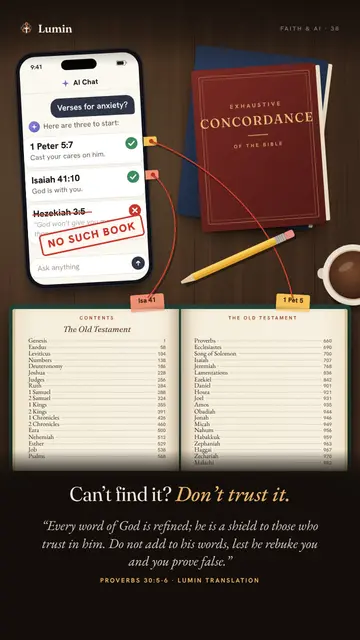 Is it a sin to use AI to study the Bible?
The older question
Work as for the Lord, not for the grade.
Colossians 3:23-24 in the Lumin Translation: “Whatever you do, put your whole self into the work, as for the Lord and not for people, since you know that the Lord will repay you with the inheritance. The Lord Christ is the one you serve.” Paul wrote that to servants whose work no one thanked them for. It changes the homework question. The assignment is not only for a teacher. It is part of how you are becoming someone who can think, and God cares who you become.
Christian teachers are already drawing this line. In Christianity Today, Dordt University’s Dave Mulder tells students he is fine with AI as long as they are open about how they use it, and that reluctance to admit it is probably a sign they are not using it well. In The Gospel Coalition, campus minister Zachariah John writes about confessing his own academic cheating, and argues that integrity costs something and is worth it.
What Scripture weighs
Truth, faithfulness, and the long work of wisdom.
The Bible never mentions homework. It says a great deal about honesty and growth.
God delights in people who deal truly.
A submitted essay says “I wrote this.” If a machine wrote it, the claim is false, even if no one ever finds out.
Put your whole self into the work.
Shortcuts that skip the learning cheat you first. The point of the assignment is the mind it builds.
Faithful in little, faithful in much.
A homework habit is small. The character it forms is not. Honesty on a quiz is practice for honesty everywhere.
Keep the rules you are under.
If a class or school forbids AI, using it anyway breaks a legitimate rule. If it allows it, follow its disclosure terms.
Get wisdom, whatever it costs.
Wisdom takes time and struggle. A tool that removes all the struggle can remove the wisdom with it.
Ask God for wisdom too.
When you are stuck, pray, then ask a teacher or classmate. AI can be one helper among several, not the only one.
Real situations
Where the line usually falls.
Class rules vary. When they are silent, honesty is the test.
Asking AI to explain a math step you do not understand, then solving it yourself
Honest study
This is tutoring. Check the explanation, since models make mistakes, and do the work in your own words.
Pasting the essay prompt in and turning in what it writes
Sin: a false claim
Your name says you wrote it. Even light editing does not make it yours.
Using AI to fix grammar in an essay you wrote
Usually fine, check the rules
Many teachers allow spelling and grammar help. If you are unsure, ask. If they would say no, do not.
Using AI on a take-home test that says no outside help
Sin: breaking your word
You agreed to the terms. Keeping them is part of dealing truly.
Making AI quizzes and flashcards from your notes
Good use
It helps you remember what you learned. The learning still happens in your head.
You already turned in AI work as your own
Confess and make it right
God forgives (1 John 1:9). Telling your teacher is hard and freeing. Accept the consequence and start clean.
Common questions
Plain answers, without invented certainty.
Is using AI for homework a sin?
Using AI to learn is not a sin. Turning in AI-written work as your own, or using AI where your class forbids it, is lying and breaking your word, and that is sin.
Is it a sin to use ChatGPT for homework?
The same test applies to any chatbot. Using ChatGPT to explain or quiz can be honest. Submitting what it wrote as your own is not.
Is using AI for homework cheating?
It is cheating when the work is graded as yours and the AI did it, or when the rules say no AI. It is not cheating when your teacher allows it and you disclose how you used it.
What does the Bible say about cheating?
Scripture condemns false weights and lying lips (Proverbs 11:1; 12:22). Cheating on schoolwork is a modern false weight: it claims more than is true.
Can Christians use AI to write essays?
Only where the assignment allows it and you say so. For most essays, the writing is the point. Use AI to brainstorm or give feedback, then write it yourself.
I used AI to cheat. What should I do?
Confess it to God, who is faithful to forgive (1 John 1:9). Then tell your teacher, accept the consequence, and set a rule for next time. Honesty now matters more than the grade.
Can I use AI for Bible homework or Sunday school?
The same rules apply. Use it to find passages and explain background, then read the verses yourself. See the guide on using AI to study the Bible.
Does Lumin do homework?
No. Lumin is a Bible companion. It answers questions about Scripture and cites verses you can open, so you can check its work and do your own.
Your version of the question
Still wondering about your situation? Ask it.
Lumin answers in a few sentences and names the passages it rests on. Each verse it cites is checked and shown in full below the answer, so you can read it yourself.
Keep going
Keep asking in the Lumin app.Keep this conversation going on the web.
The same short answers with the verse beside each one, plus your saved questions, prayer, and the whole Bible to read in.
Make a free Lumin account and this conversation opens in Ask, ready for your next question. Your saved questions, prayer, and the whole Bible come with it.
Sources and further reading
Open the evidence behind the answer.
These sources provide the technical, research, and Christian context used in this guide. The biblical references above should also be read in their full literary and church context.
Christian journalism
The Christian Colleges Welcoming ‘Socratic Bots’
How Christian colleges are adopting AI tools built to prompt thinking rather than give answers, with educators asking students to be open about their use.
Christianity TodayChristian reflection
Take It from Me, Don’t Use AI to Cheat in School
A campus minister recounts confessing to academic cheating and argues that integrity costs something and brings a student closer to Christ.
The Gospel CoalitionEvangelical ministry statement
Brentwood Statement on Artificial Intelligence and Christian Ministry
A June 2026 statement from Southern Baptist leaders on wisdom, human dignity, truthfulness, trust, privacy, and faithful leadership in ministry use of AI.
Lifeway Christian Resources and Southern Baptist leadersChristian ethical reflection
When creation creates technology
ERLC research on the creation mandate, human stewardship, and why artificial intelligence remains a human-made tool—not a moral agent.
Ethics & Religious Liberty CommissionEditorial theology
Christians Can Give Two Cheers for AI
TGC argues for hopeful realism: AI reflects human creativity under the creation mandate but cannot receive the wisdom or moral weight that belong to God.
The Gospel CoalitionChristian ethical reflection
Antiqua et nova: Artificial Intelligence and Human Intelligence
The Vatican’s 2025 note distinguishes functional machine output from embodied, relational human intelligence. Lumin cites it as one Christian contribution, not a universal denominational statement.
Dicasteries for the Doctrine of the Faith and for Culture and EducationEditorial theology
When We Make Intelligence in Our Image
Christianity Today on the creation mandate, human personhood, and welcoming AI as human creativity without anthropomorphizing or idolizing it.
Christianity Today