
A direct biblical answer
Is using AI a sin?
No—not merely because it is AI. Scripture does not name modern AI or condemn a tool in the abstract. Sin enters through what we do with it: deception, taking what is not ours, harming a neighbor, avoiding responsibility, ignoring conscience, or giving a tool authority it should not have. An honest, accountable use can be permissible; the same tool can be used sinfully.
The direct answer
Is using AI a sin?
No—not merely because it is AI. Scripture does not name modern AI or condemn a tool in the abstract. Sin enters through what we do with it: deception, taking what is not ours, harming a neighbor, avoiding responsibility, ignoring conscience, or giving a tool authority it should not have. An honest, accountable use can be permissible; the same tool can be used sinfully.
The tool is not the verdict. AI can support honest study, accessibility, organization, and creative work. Its presence alone does not settle the moral question.
Your use still carries weight. Intention matters, but so do truthfulness, permission, consequences, habits, and the responsibility you may be tempted to hand away.
Watch · Faith & AI 01
The answer in under a minute.
The question, the short answer, and the Scripture to test it against. Every verse on screen is quoted from the Lumin Translation as it read when the film was made (edition 1.0); the linked passages show the current text.
Read what’s on screen
- The question Is using AI a sin? The internet has opinions: “yes. full stop.” “it’s literally just a tool.” “only if you cheat with it.”
- The short answer Not by itself. The Bible never names AI. Sin shows up in how we use it.
- Am I telling the truth? “…having put off falsehood, each of you speak truth with his neighbor.” Ephesians 4:25
- Am I loving the person it affects? “You shall love your neighbor as yourself.” Mark 12:31
- Is it starting to master me? “Everything is permitted for me, but I will not be mastered by anything.” 1 Corinthians 6:12
- The takeaway The tool isn’t the verdict. The use is. Honest use can be fine. Deceptive use isn’t.
Up next · Faith & AI 02
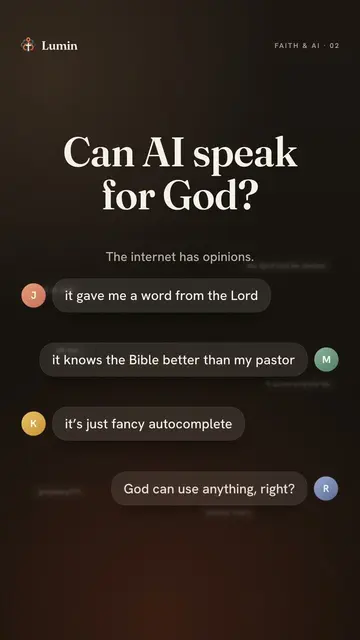 Can AI speak for God?
Ask the better question
What am I asking AI to help me do?
A calculator can help someone learn or help someone cheat. AI is similar in that its moral meaning depends partly on the use—but AI also makes it unusually easy to imitate a person, hide authorship, expose private information, and accept a confident answer without understanding it.
Christian discernment therefore goes beyond saying “it is only a tool.” Ask whether the use tells the truth, loves the person affected, honors the work entrusted to you, respects permission, strengthens wise judgment, and keeps technology from taking a place it cannot faithfully hold.
Six questions before you use it
A practical test for conscience and conduct.
These questions do not produce an automatic answer for every situation. They make the moral stakes visible enough to decide honestly.
Ephesians 4:25 · Proverbs 12:22
Am I telling the truth?
Do not present generated work, invented sources, or an imitated voice as something it is not. If the use depends on concealment, that is a warning.
Am I loving the person affected?
Consider the student, teacher, client, coworker, creator, congregation, or friend on the other side of the output—not only your convenience.
Am I doing the work faithfully?
Assistance is different from avoidance. Use a tool to strengthen the work you are responsible for, not to manufacture the appearance that you did it.
Am I overriding conscience?
A troubled conscience deserves attention. Clarify what feels wrong, seek wisdom, and do not train yourself to ignore conviction merely because a shortcut is available.
Do I have permission?
Private data, another person’s work, and confidential conversations are not yours to upload simply because a tool will accept them.
Is this beginning to master me?
Notice whether AI is weakening attention, replacing relationships, feeding compulsion, or becoming the first and final voice you consult.
Common situations
Where assistance becomes dishonesty.
Rules from a teacher, employer, client, publisher, or platform matter. Within those boundaries, these are useful starting judgments.
Brainstorming or improving grammar in your own draft
Usually permissible
Keep your judgment active, verify the result, and disclose assistance when the setting expects it.
Summarizing notes or exploring a Bible passage
Usually permissible—with checking
Read the source yourself. AI can support understanding, but it should not become the source or final interpreter.
Submitting AI output as homework or paid work you were expected to do
Wrong when it deceives
If the other person reasonably believes the work is yours, concealment turns assistance into misrepresentation.
Inventing quotations, citations, evidence, or another person’s voice
Do not do it
A plausible fabrication is still false, and imitating someone without consent can damage trust or reputation.
Uploading private, pastoral, medical, client, or workplace information
Not without authority
Remove identifying details and follow the rules that govern the information. Convenience does not create permission.
Asking AI to replace prayer, conscience, a pastor, or Christian community
The tool is in the wrong role
A model can arrange words. It cannot know God for you, bear pastoral responsibility, or become an accountable relationship.
Common questions
Plain answers, without invented certainty.
Is using AI a sin in the Bible?
No. The Bible never names modern AI or condemns a tool in the abstract. Sin enters through what we do with it: deception, taking what is not ours, harming a neighbor, avoiding responsibility, ignoring conscience, or giving software the authority that belongs to Scripture, wise counsel, and God. An honest, accountable use can be permissible.
Is it a sin to use AI?
Not simply because it is AI. Ask whether the use tells the truth, loves the person affected, honors the work entrusted to you, respects permission, and keeps the tool from taking a place it cannot faithfully hold.
Is using AI for homework a sin?
Using AI to explain a concept, quiz you, or improve a draft may be allowed. Submitting generated work as your own when a teacher expects your work is deception. Follow the assignment rules, ask when they are unclear, and be able to explain what you submit.
Is using AI to study the Bible a sin?
Not inherently. AI can help locate passages, organize context, or form questions. Read the passage itself, check every claim, and do not give a generated answer the authority of Scripture, the Holy Spirit, wise teachers, or the church.
Is using AI for writing or art a sin?
Not automatically. The questions are whether the use is honest, permitted, and respectful of other people’s work; whether a client, audience, teacher, or collaborator is being misled; and whether you remain responsible for what you publish.
Can AI write a prayer for me?
AI can suggest language, much as a prayer book can. But prayer is not the production of polished words. Speak honestly to God, use borrowed words as a help rather than a performance, and do not confuse generated language with a relationship.
Does AI have the Holy Spirit or spiritual authority?
No. AI is human-built software. It may reproduce theological language, but it does not pray, discern, bear pastoral responsibility, or speak for God. Treat spiritual certainty from a model as a reason to slow down and check the source.
How can a Christian use AI responsibly?
Tell the truth about how it was used, verify the result, protect private information, respect the rules of the setting, consider the people affected, keep a responsible human accountable, and never give the tool spiritual authority. If you want a Bible companion that publishes its limits, the Lumin Covenant lists what it will and will not do.
Your version of the question
Still wondering about your situation? Ask it.
Lumin answers in a few sentences and names the passages it rests on. Each verse it cites is checked and shown in full below the answer, so you can read it yourself.
Keep going
Keep asking in the Lumin app.Keep this conversation going on the web.
The same short answers with the verse beside each one, plus your saved questions, prayer, and the whole Bible to read in.
Make a free Lumin account and this conversation opens in Ask, ready for your next question. Your saved questions, prayer, and the whole Bible come with it.