Faith, apologetics, and artificial intelligence
Does ChatGPT believe in God?
No, ChatGPT does not believe in God, and it does not disbelieve in him either. It has no beliefs at all. It predicts likely text, shaped by its training, its makers’ rules, and the way you ask.
The direct answer
Does ChatGPT believe in God?
No, ChatGPT does not believe in God, and it does not disbelieve in him either. It has no beliefs at all. It predicts likely text, shaped by its training, its makers’ rules, and the way you ask. That is why one viral chat has it “admit” that God exists and another has it “admit” it is an atheist. A chatbot’s yes is not evidence for God, and its no is not evidence against him. The arguments it repeats are human arguments, and they stand or fall on their merits. Faith is more than agreeing that God exists. It is a person trusting God and seeking him, which no program can do.
What ChatGPT is doing. Predicting the next words from patterns in its training, steered by its makers’ rules and by your prompt. It can lay out an argument for God or against him. It holds neither view.
What it cannot do. Believe, doubt, pray, or trust. Its agreement adds no weight to an argument, and its refusal takes none away. Faith belongs to persons whom God made and speaks to.
Your version of the question
Still wondering about your situation? Ask it.
Lumin answers in a few sentences and names the passages it rests on. Each verse it cites is checked and shown in full below the answer, so you can read it yourself.
Keep going
Keep asking in the Lumin app.Keep this conversation going on the web.
The same short answers with the verse beside each one, plus your saved questions, prayer, and the whole Bible to read in.
Make a free Lumin account and this conversation opens in Ask, ready for your next question. Your saved questions, prayer, and the whole Bible come with it.
Real situations
When a chatbot talks about God.
Most people meet this question through a clip, a screenshot, or a late-night chat. Tap the one closest to yours.
A friend shares a clip titled “ChatGPT admits God exists”
Share the argument, not the verdictThe argument from contingency is centuries old, with versions in Aquinas and Leibniz. Talk about that. A case resting on a chatbot’s agreement falls with the next clip.
A skeptic shows you ChatGPT calling itself an atheist, or saying God is unlikely
Not evidence eitherA bot’s no carries the same weight as its yes: none. Ask what argument it gave, and weigh that argument the way you would weigh a person’s.
Your teenager says ChatGPT told them God probably isn’t real
Stay calm and look at it togetherAsk to see the chat and the argument it gave. Then read together how Christians have answered it. Your calm shows that faith can face hard questions.
Asking a chatbot late at night whether God is real
Bring the question to God and to a personDoubt is nothing to hide. Pray the words of the boy’s father in Mark 9:24, “I believe; help my unbelief!” Then tell a pastor or Christian friend what you are wrestling with.
A faith app’s chatbot tells you “I believe in Jesus too”
Be wary of the claimSoftware that claims faith is claiming something it cannot have. Look for tools that cite Scripture you can open and are honest about what they are.
Someone you know says ChatGPT is God, or speaks to them for God
Gently name what is happeningTreating a chatbot as God, or as his voice, is misplaced worship and can signal distress. Stay close, open Scripture together, and help them see a pastor and, if needed, a doctor. See the idolatry guide.
Watch · Faith & AI 34
The answer in under a minute.
The question, the short answer, and the Scripture to test it against. Every verse on screen is quoted from the Lumin Translation as it read when the film was made (edition 2.0); the linked passages show the current text.
Read what’s on screen
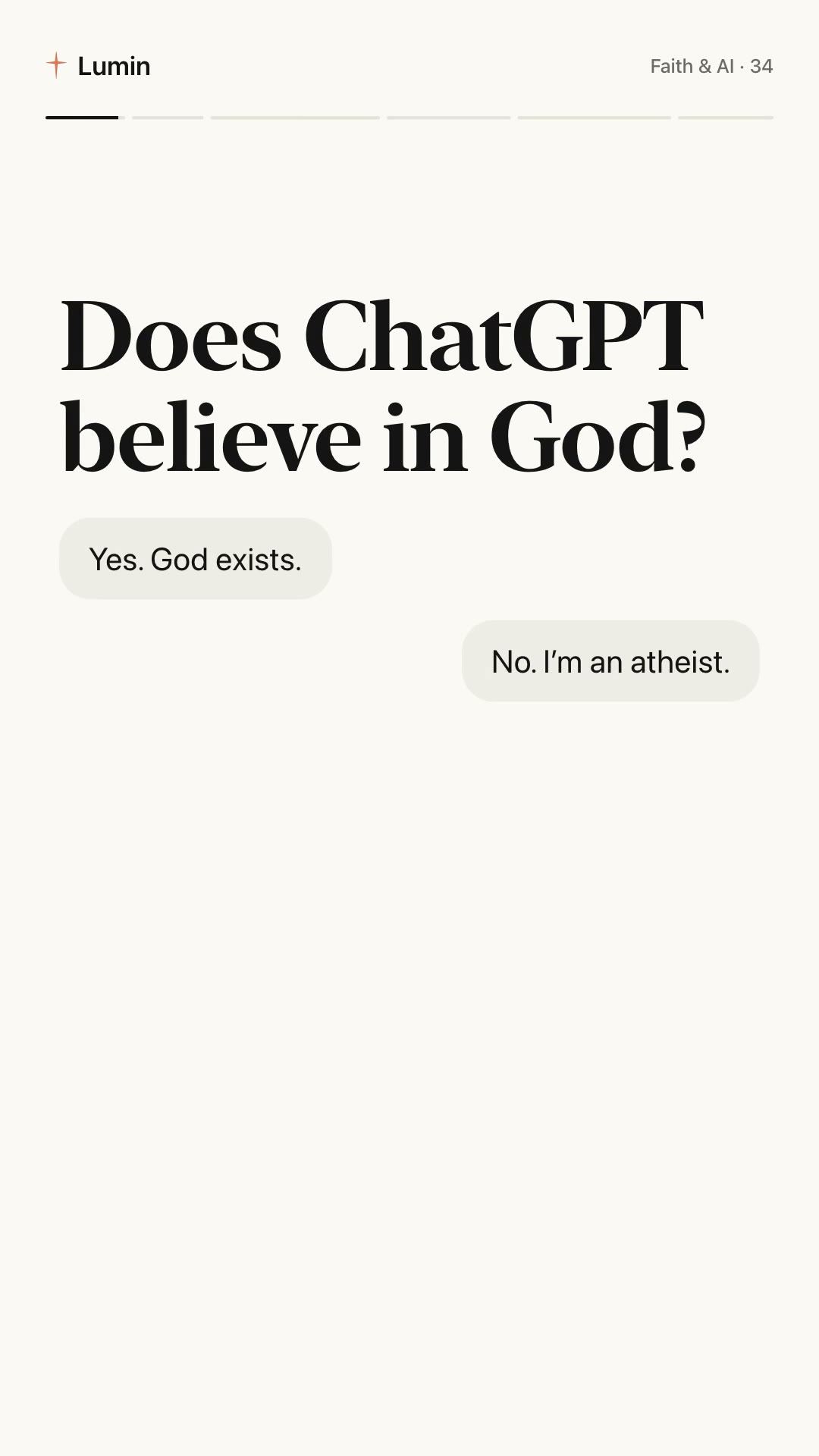
- The question Does ChatGPT believe in God? “Yes. God exists.” “No. I’m an atheist.”
- The short answer No. It has no beliefs. It predicts likely text.
- Faith is more than saying he exists. “…anyone who comes to God has to believe that he exists and that he gives a reward to those who search for him.” Hebrews 11:6
- Even a right answer falls short. “You believe that God is one. Good! Even the demons believe that, and they shudder.” James 2:19
- Faith can’t be engineered. No upgrade can make it believe. “So faith comes from what is heard, and what is heard comes through the word of Christ.” Romans 10:17
- Only a person can believe. A chatbot can say yes. “…I believe; help my unbelief!” Mark 9:24
Up next · Faith & AI 35
 Is AI porn a sin?
The older question
Faith is more than saying God exists.
Hebrews 11:6 in the Lumin Translation: “Without faith, pleasing him is impossible, because anyone who comes to God has to believe that he exists and that he gives a reward to those who search for him.” The verse describes a person coming to God. That person believes God exists and trusts that he rewards those who search for him. A chatbot can be led to type both. It cannot mean them. It comes to no one and searches for nothing.
The question keeps going viral. Alex O’Connor, an atheist YouTuber, walked ChatGPT through the argument from contingency, premise by premise, until it said God exists. UNILAD Tech wrote it up, and a Christian Post column ran under the headline “ChatGPT says it’s a fact that God exists.” A 2023 blog post ran under the opposite headline: “ChatGPT admits it is an atheist.” The answers flip because a model predicts likely text, steered by its training, its makers’ rules, and your framing. Ask it to argue for God, then against him. It will usually do both.
What Scripture weighs
Faith is a person’s trust, not a program’s output.
No verse mentions chatbots. These passages show what faith is, and why a machine’s agreement cannot stand in for it.
Faith is confidence and conviction.
Hebrews calls faith confidence in things hoped for and conviction of things not seen. A model hopes for nothing and is convinced of nothing, whatever it types.
Even a correct belief can fall short.
Even the demons believe that God is one, and shudder. A correct sentence about God is not saving faith. A chatbot’s correct sentence is not even belief.
Faith lives in the heart and speaks with the mouth.
Paul joins believing in the heart with confessing with the mouth. A model’s accurate words about God confess nothing, because no heart stands behind them.
Creation speaks of God without believing.
The heavens proclaim God’s glory, and Romans 1:20 says his power is seen in what he made. Stars testify without believing. A model can repeat true things people wrote about God without believing them.
The first speaker seems right until questioned.
The first to state his case seems right until a neighbor cross-examines him. A chatbot tends to agree with whoever asks. Test an argument by its best objection, not a machine’s nod.
Give a reason for the hope that is in you.
Be ready to give a reason for your hope, Peter says, with meekness and fear. A bot’s agreement cannot stand in. The hope must be yours, and so must the reason.
Common questions
Plain answers, without invented certainty.
Does ChatGPT believe in God?
No. ChatGPT has no beliefs at all. It predicts likely text shaped by its training, its makers’ rules, and your prompt. Ask as a believer, then as a skeptic, and the answer may shift.
Does AI believe in God?
No AI believes in God, because belief takes a person who can trust. What a chatbot says about God depends on how its makers tuned it and how you ask, so ChatGPT, Claude, Gemini, and Grok may answer differently. None of that is faith.
Did ChatGPT admit that God exists?
In a widely shared video, Alex O’Connor, an atheist YouTuber, led ChatGPT through the argument from contingency until it said God exists. That shows the argument can be laid out step by step. It does not show the bot believes it, and other prompts lead it elsewhere.
Is ChatGPT an atheist?
No. A 2023 blog post ran under the headline “ChatGPT admits it is an atheist.” But having no beliefs is not the same as rejecting God. ChatGPT holds no convictions either way. No program does.
Can AI prove God exists?
No. AI can lay out human arguments, such as the centuries-old cosmological and moral arguments or the newer fine-tuning argument. Those stand or fall on their merits. A chatbot agreeing with them adds no weight.
Why won’t ChatGPT say Jesus is Lord?
ChatGPT is generally tuned to describe contested beliefs rather than affirm them, so it usually describes what Christians believe. Typing the words would not be a confession anyway. When Paul says no one can say “Lord Jesus” unless by the Holy Spirit (1 Corinthians 12:3), he means a confession of the heart.
Can AI pray or worship God?
No. Prayer and worship are a person turning to God in spirit and truth. A model can generate a prayer’s words but cannot mean them. The guide on whether AI has a soul explains why.
Could AI ever have faith?
Nothing in Scripture suggests faith can be engineered. Faith comes from hearing the word of Christ (Romans 10:17). When Peter confessed Jesus as the Christ, Jesus said his Father had revealed it, not flesh and blood (Matthew 16:17). A better machine would still only imitate trust.
Can I use AI to study arguments for God?
Yes, as a study aid. Ask it to explain an argument and its best objections. Then read the thinkers themselves, check every claim, and learn the arguments well enough to give your own reasons.
Does Lumin believe in God?
Lumin is software, so it has no faith of its own and claims none. It answers with Scripture you can open, will not speak as God or Jesus, and points you back to God, your church, and people who can pray with you.
Sources and further reading
Open the evidence behind the answer.
These sources give the technical, research, and Christian background for this guide. Read the Bible passages above in context too: the whole book, and how the church has read them.
Tech news
Man convinces OpenAI’s ChatGPT that ‘God exists’ in captivating conversation with the chatbot
A write-up of Alex O’Connor’s conversation in which ChatGPT, step by step, came to say that God exists.
UNILAD TechChristian commentary
ChatGPT says it’s a fact that God exists
A Christian Post opinion column on the O’Connor exchange and the argument from contingency.
The Christian PostBlog post
ChatGPT admits it is an atheist
A 2023 blog post whose headline claims ChatGPT admitted to being an atheist.
Reason and MeaningPrimary source
Sycophancy in GPT-4o: What happened and what we’re doing about it
OpenAI explains why it rolled back a 2025 ChatGPT update that was overly flattering or agreeable toward users.
OpenAICultural commentary
Tens of Thousands of AI Users Now Believe ChatGPT Is God
Ted Gioia on users who have come to believe that ChatGPT is God.
The Honest Broker